Raising My First Turkeys
 Continued from Talking Turkey (Part 1)
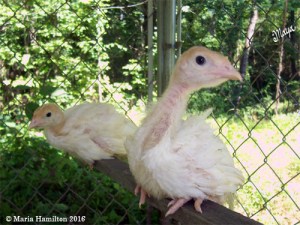
A few years after my mother retired from the turkey plant I found myself living in the Blue Ridge Mountains of North Carolina and starting an organic farm. I recall one day seeing a few very cute turkey poults among my friends chicken flock and having a desire to get a few of my own. I had gotten accustomed to the wild turkeys in the yard, but I had never raised poultry before. A few years of fast lessons lay ahead. I made a cage to keep our cute baby turkeys safe from wildlife and loose dogs and started reading up on exactly what turkeys eat and need.
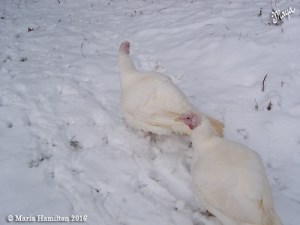
It did not take long for my cute poults to grow into awkward skinny teens and then into plump, heavy adult turkeys. I had purchased modern broad breasted white turkeys, a breed selected to grow to market size in about six months with a fair amount of breast meat. This might be great for food processors like the turkey plant my mother retired from, but I had fallen in love with these two birds who turned out to be much more clever than anyone but bird lovers give them credit for. Being inexperienced, I also sexed them incorrectly and assumed they were male birds until they started laying eggs and I realized my error.
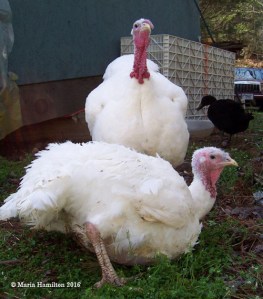 Thanks to modern science, my pet turkey hens were the bird equivalent of Dolly Parton before her reduction surgeries. I had to build a handicap ramp into the coop for one of my birds who was so top heavy, she would fall trying to go down stairs or have to be carried into the coop. I am sure their backs hurt as much as mine did trying to carry them. While one of my turkeys, Hooverette, managed to stay active and fit, the other, Ms. Pat, had all the same health problems associated with obesity. I tried diet and exercise to no avail. She had trouble walking and breathing and would accidentally crush eggs in her nest and become frustrated with herself. She was jealous of the other healthier bird and it showed in her disposition. They would eventually succumb to health problems and attacks by animals like wild raccoons. If I had known they were never intended to live beyond six months or that they would suffer numerous health problems, we would have made different decisions. I learned that modern turkeys are too heavy to mate naturally and that if I ever wanted to raise turkeys again, we would only raise the semi-forgotten heritage breed turkeys.
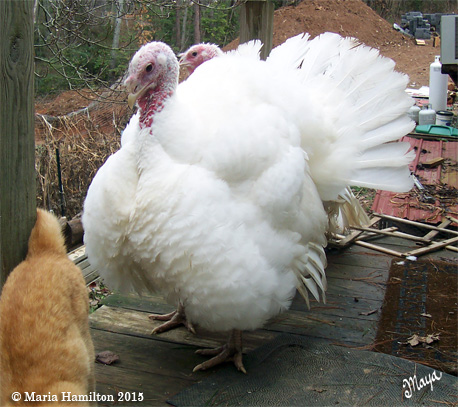 None the less, for over two years, I gave my two turkeys the best life I could. Some part of me remembered the factory turkeys and their sad lives. I didn’t know what to do for them, but I could give these two turkeys a real life on my farm. They had a large, comfortable coop, dirt bath boxes, healthy foods, spring water, treats from the garden and frequent companionship. They took long walks around the farm and often worked beside me in the gardens. If I was digging potatoes, they would go through the rows behind me and roll out little ones I had missed. They also performed pest control duties, played games with cherry tomatoes, were mothers to our ducks and knew how to knock on my door if I ever forgot to feed them. I let them free range in the backyard during parties and they would join circles with my guests, often gobbling at jokes everyone laughed at. They were social and friendly, although they could steal a sandwich out of unobservant person’s hand in a heartbeat. Overall they were spoiled and loved by many. Contrary to all the hype about bird brains and turkeys being stupid, they were not only smart, but sensitive with distinct personalities. Our turkeys became ambassadors for their species and convinced quite a few people those myths about turkey intelligence were just untrue.
From birth to death, I learned much about modern turkeys. I had watched them grow and long for children, talk to the neighborhood wild turkeys and sneak off for a tryst with one. They laid and tended eggs, shared a nest, adopted ducklings and were mothers to a flock of ducks. They cooed and preened, rolled in the dirt, had naps under trees and brought me endless joy. They also introduced me to the troubles of modern turkeys and inspired me to learn about the beautiful heritage breed turkeys, the old standbys of the settler and homestead days that were dwindling in numbers without people to raise them, but were modest in size and could still fly and breed naturally. I did not have the resources to raise and breed the heritage turkeys, but I could talk about them, encourage my farm and ranch friends to keep them and I could raise awareness about them.
Read more about heritage turkeys at the American Livestock Breed Conservancy
…continued in Talking Turkey (Part 3) | Living with Wild Turkeys


2 Comments Add yours